Blog
Top 5 ATM Security Threats in 2026 (And How to Prevent Them)
ATM threats in 2026 are becoming more advanced, combining jackpotting, shimming, skimming, cash trapping, physical attacks, and cyber vulnerabilities. This article explains the top risks and prevention strategies ATM operators can use to improve security.
July 6, 2026
 ChatGPT
 Grok
Grok Perplexity
 Claude
ATMs remain one of the most important touchpoints in the financial ecosystem, but the threats targeting them are becoming more sophisticated every year. Criminals are no longer relying only on traditional skimming devices or physical break-ins. Today’s ATM attacks combine cyber intrusion, physical manipulation, malware deployment, and advanced fraud techniques that target both machines and customers.
As ATM technology evolves with contactless payments, mobile integrations, and connected banking systems, financial institutions and ATM operators must strengthen their security strategies to keep pace with modern threats.
This article explores the top ATM security threats in 2026 and the technologies and strategies institutions can use to prevent them.
Why ATM Security Is Becoming More Complex
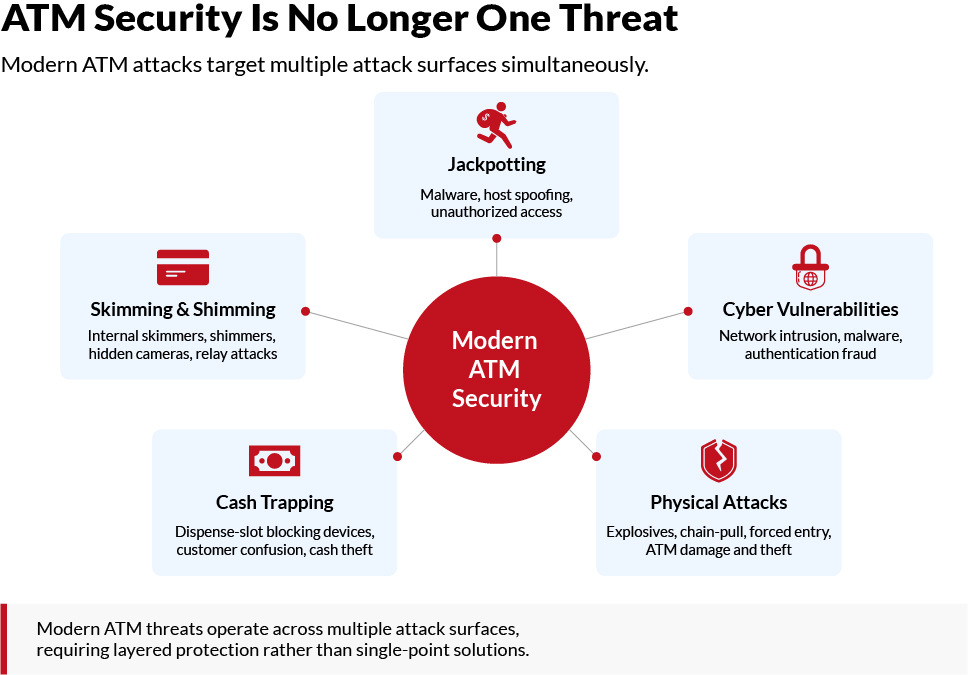
The modern ATM environment now faces threats across multiple layers:
- Physical attacks
- Card data compromise
- Malware and logical attacks
- Network vulnerabilities
- Authentication fraud
- Customer targeted crime
Industry experts are also seeing growing concern around:
- Cash trapping
- Explosive ATM attacks
- Direct memory access attacks
- Malware-based jackpotting
- Host spoofing
- Relay attacks
- Internal skimmers and shimmers
At the same time, banks and ATM operators are managing compliance changes, operating system upgrades, and growing customer demand for faster, contactless banking experiences.
This combination is reshaping how ATM security must be approached in 2026.
1. ATM Jackpotting Attacks
ATM jackpotting remains one of the most serious ATM security threats facing financial institutions today.
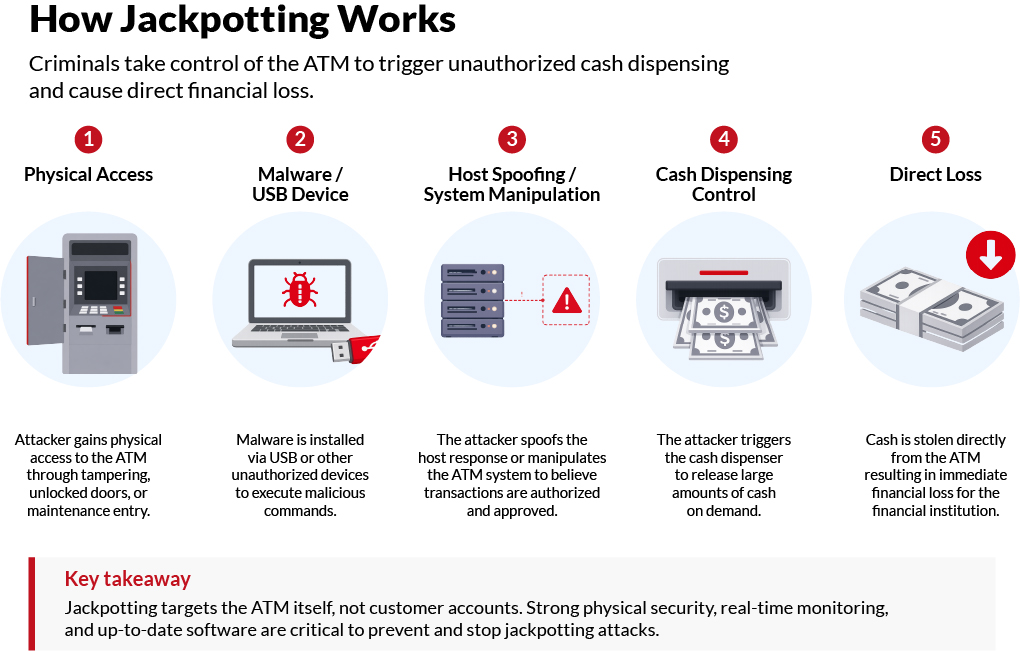
In a jackpotting attack, criminals gain physical access to the ATM and install malware or unauthorized devices that allow them to control the machine’s cash dispensing function. In some cases, attackers spoof the acquirer’s host system response, enabling unlimited cash withdrawals directly from the ATM.
Unlike traditional ATM fraud, jackpotting targets the ATM itself rather than customer accounts.
Common Jackpotting Methods
- Malware installation
- Direct memory access attacks
- Unauthorized USB devices
- Host spoofing
- Internal network manipulation
Older ATM systems running unsupported operating systems or outdated software are especially vulnerable.
How to Prevent Jackpotting
Use Multi-Layer Security
Multi-layer security integrates overlapping protection across physical, software, network, and authentication layers. If one security control fails, additional protections remain active.
Keep Systems Updated
Continuous software lifecycle management reduces exposure to outdated systems and unpatched vulnerabilities.
Strengthen Physical Access Controls
High security locks, tamper sensors, and controlled technician access reduce the risk of unauthorized physical entry.
Deploy Real-Time Monitoring
AI-powered monitoring systems can detect suspicious activity and abnormal ATM behavior before major losses occur.
2. ATM Shimming and Advanced Skimming
Although EMV chip cards improved payment security, attackers adapted quickly through shimming techniques.
ATM shimming involves inserting a thin device containing a microprocessor and flash memory inside the ATM card reader. The device intercepts or manipulates data passing between the card’s EMV chip and the ATM interface.
Traditional ATM skimming is also still widely used. In these attacks, criminals attach a scanning device over the ATM card reader slot to capture magnetic stripe data and create cloned cards.
Modern fraud techniques now include:
- Internal skimmers
- Embedded shimmers
- Relay attacks
- Hidden cameras
- Wireless data transmission
Why These Attacks Are Dangerous
Shimmers are difficult to detect because they are hidden inside the machine rather than attached externally.
Advanced skimming methods can compromise customer card data without obvious signs of tampering.
How to Prevent Skimming and Shimming
Install Advanced Anti-Skimming Readers
Modern anti-skimming readers can detect external skimmers and embedded fraud devices.
Use Internal Device Detection Technologies
Internal detection systems identify unauthorized hardware inside the ATM card reader.
Transition to Contactless Transactions
Contactless and cardless transactions reduce reliance on physical card insertion, lowering exposure to skimming attacks.
Perform Routine ATM Inspections
Regular inspections help identify tampering before customers are affected.
3. Cash Trapping Attacks
Cash trapping is an emerging ATM fraud tactic generating increasing concern in some markets.
In a cash trapping attack, criminals insert a device into the ATM cash dispensing slot that blocks bills from being presented to the customer. The ATM records the transaction as completed, leading the customer to believe the machine malfunctioned.
After the customer leaves, the criminal retrieves the trapped cash.
Why Cash Trapping Is Effective
- Difficult for customers to identify
- Leaves little visible evidence
- Often targets unattended ATM locations
- Can occur quickly in high traffic environments
How to Prevent Cash Trapping
Upgrade ATM Shutter Protection
Modern ATM shutters are designed to detect and resist trapping devices.
Improve Surveillance
Visible cameras and monitoring systems discourage fraudulent activity.
Train Customers and Staff
Users should immediately report transactions where cash is not dispensed correctly.
Use AI-Based Monitoring
Behavioral monitoring systems can identify repeated suspicious ATM activity patterns.
4. Physical ATM Burglaries and Explosive Attacks
Physical ATM attacks remain a major security concern in 2026.
Criminals continue attempting to breach ATM safes either on site or after moving the ATM to a secondary location. Common methods include:
- Brute force attacks
- Explosives
- Hook and chain attacks
- Forced cabinet entry
- Power tool intrusion
Explosive ATM attacks are particularly concerning because they create serious risks for customers, employees, and surrounding property.
How to Prevent Physical ATM Attacks
Deploy Ink Protection and Cash Neutralization Systems
Ink protection systems permanently stain cash during forced attacks, eliminating the economic incentive behind the crime.
Improve ATM Anchoring and Safe Protection
Reinforced ATM installations reduce the ability to remove or breach machines.
Increase Physical Surveillance
Lighting, cameras, and alarm systems improve detection and response times.
Use Reinforced ATM Enclosures and Safe Protection
One of the most effective ways to reduce the risk of ATM theft and vandalism is to add a physical security enclosure designed to resist common attack methods.
ATM Link’s Slim Security Enclosure adds an extra layer of protection around the ATM safe, helping deter criminals before significant damage occurs. Built with a heavy-duty steel shell, reinforced locking mechanisms, and ground-bolt anchoring points, Slim Armor is specifically designed to resist prying, forced-entry attempts, smash-and-grab thefts, and chain-pull attacks.
Key security benefits include:
- Heavy-duty steel construction for enhanced physical protection
- Reinforced locking system that helps resist crowbar attacks
- Ground-bolt anchoring options to reduce theft attempts
- Added weight and resistance that make ATM removal significantly more difficult
- Increased response time during an attack, improving the effectiveness of surveillance and alarm systems
Rather than relying on a single security measure, solutions like Slim Armor work best as part of a layered security strategy that combines physical protection, monitoring, surveillance, and operational controls. This approach helps reduce both financial losses and costly ATM downtime caused by break-in attempts.
5. Logical and Cyber Vulnerabilities
Modern ATMs are increasingly connected to banking networks, making logical and cyber vulnerabilities a growing risk area.
Attackers are targeting:
- ATM software
- Authentication systems
- Network communications
- Host connections
- Remote management tools
Threats now include:
- Malware attacks
- Host spoofing
- Relay attacks
- Network intrusion
- Authentication bypass techniques
As ATM infrastructure becomes more connected, institutions must secure both physical hardware and digital systems.
How to Prevent Cyber ATM Attacks
Implement Multi-Layer Security Architecture
Combining overlapping security controls across software, networks, and authentication systems significantly reduces the likelihood of full compromise.
Use AI and Machine Learning
Artificial intelligence improves anomaly detection, predictive monitoring, and real-time fraud identification.
Secure Software Lifecycles
Continuous updates and security patching reduce exposure to known vulnerabilities.
Modernize Authentication Methods
One-time PIN functionality, QR authentication, and mobile-integrated verification strengthen transaction security.
How Contactless and Cardless Banking Improves ATM Security
Contactless payments and cardless withdrawals are becoming important tools for reducing ATM fraud exposure.
Technologies such as:
- NFC transactions
- QR code authentication
- Mobile wallet integration
- One-time PIN verification
reduce dependence on physical card insertion, helping prevent skimming and card capture attacks.
These technologies also align with consumer expectations for faster and more seamless banking experiences.
When deployed properly, contactless technologies improve both convenience and security.
Compliance Changes Can Create Security Opportunities
Regulatory updates, PCI compliance requirements, and operating system transitions often require ATM upgrades.
Rather than viewing these mandates only as operational costs, financial institutions can use them strategically to modernize ATM fleets with stronger security technologies.
When hardware or software upgrades are already necessary, implementing advanced protection capabilities becomes more financially efficient.
This approach helps institutions strengthen long-term ATM resilience while meeting compliance requirements.
The Future of ATM Security
ATM security is shifting toward proactive defense strategies powered by:
- Artificial intelligence
- Predictive monitoring
- Multi-layer security
- Real-time analytics
- Advanced authentication
- Continuous software management
The future of ATM protection will depend on integrating physical, digital, and network security into a single coordinated framework.
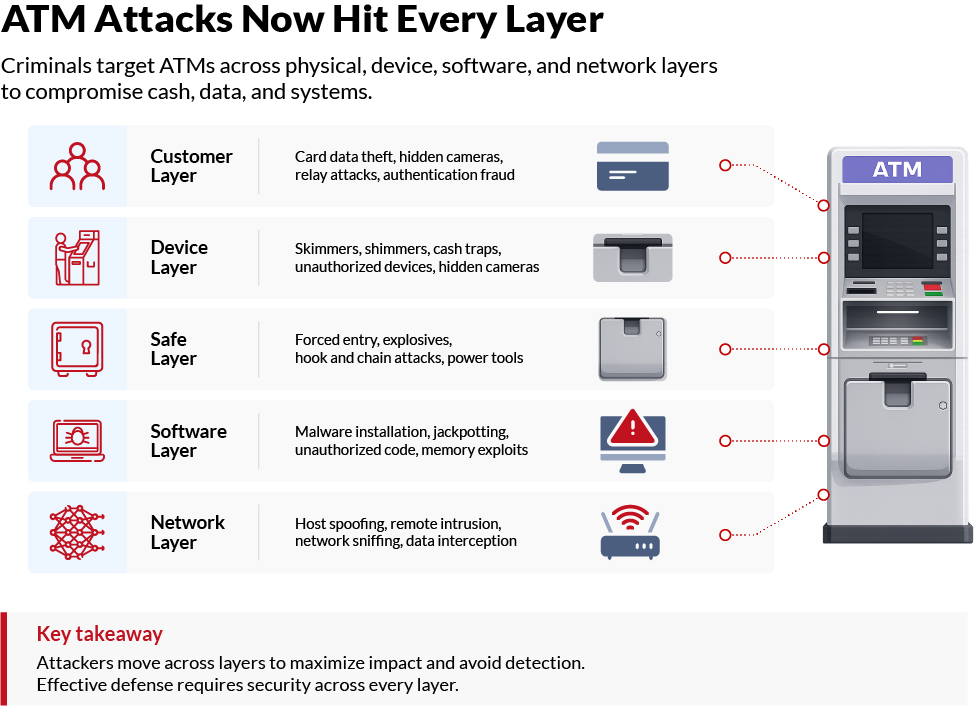
Institutions that modernize early will be better positioned to reduce fraud exposure, maintain customer trust, and improve operational stability.
Final Thoughts
ATM threats are becoming more sophisticated and more connected every year.
From jackpotting and shimming to explosive attacks and logical vulnerabilities, financial institutions must prepare for threats that target both physical infrastructure and digital systems simultaneously.
Modern ATM security is no longer only about protecting cash. It is about protecting customer data, operational continuity, and long-term trust.
Organizations that adopt multi-layer security, advanced monitoring technologies, and modern authentication systems will be far better prepared for the next generation of ATM attacks.
Sources
- American Bankers Association ATM Security Resources
- ATM Marketplace – Preparing ATM Networks for the Next Generation of Attacks
Included In This Story

ATM Link, Inc.
YOUR MAJOR RESOURCE FOR ATM PROCESSING, PRODUCTS, AND SERVICES
For over 27 years, ATM Link, Inc. has been helping retailers maximize profits with hassle-free ATM solutions. From transaction processing to full-service programs, quality ATMs, and expert support, we’ve got you covered nationwide. We prioritize customer satisfaction, security, and transparency, ensuring smooth operations and increased earnings
Related Media
SecurityPresented ByDiebold Nixdorf
Featured Vendor

Simple | Secure | Service | Solutions. From ATM sales, support, and service to enterprise security solutions with Next Generation technology. Think CSG First. We Make it Happen!
Subscribe
Get the latest news and resources from ATM Marketplace.