Blog
Managing Rapid Change in States-and-Screens ATMs
Windows modernization, security patch cadence, and operational change are introducing new risks—not at the XFS service layer, but in configurations themselves.
April 9, 2026
 ChatGPT
 Grok
Grok Perplexity
 Claude
Not every ATM estate has moved to stateless, Advanced Function architectures.
Across the globe, many institutions continue to rely on states-and-screens ATMs that are stable, proven, and deeply integrated into daily operations.
But just as with Advanced Function ATM estates, these environments are under pressure.
Windows modernization, security patch cadence, and operational change are introducing new risks—not at the XFS service layer, but in configurations themselves.
The Reality of States-and-Screens ATMs in 2026
States-and-Screens ATMs depend on:
- Load files
- State tables
- Screen flows
- Conditional logic embedded in configuration
When these configurations drift—or are updated inconsistently—the ATM doesn’t degrade gracefully. It fails visibly.
In 2026, teams managing these environments face
- More frequent OS patches
- Tighter security baselines
- Continued support for legacy configurations
- Pressure to deploy changes faster, with fewer errors
What was once manageable manual work has become a scaling problem.
Why OS Modernization Is Still a Configuration Problem Here
Unlike Advanced Function ATMs, states-and-screens machines are explicitly dependent on configuration accuracy.
OS updates and security changes introduce risk by:
- Invalidating assumptions baked into load files
- Exposing timing or sequencing issues in screen flows
- Requiring configuration changes to meet new security or compliance rules
Even when the OS update itself is successful, configuration errors are often the cause of outages.
Common Failure Modes in States-and-Screens Estates
Configuration Drift
Slight differences between regional or OEM-specific load files accumulate over time, leading to inconsistent behavior across the fleet.
Manual Errors Caused by Time Pressures
When security patches must be deployed quickly, manual edits to states and screens increase the risk of:
- Broken navigation
- Incomplete transaction flows
- Customer visible errors
Legacy Dependency Risk
Many institutions must continue to support legacy configurations while modernizing their tooling—making change management harder, not easier.
Why Traditional Approaches No Longer Scale
Historically, configuration management relied on:
- Manual edits
- Local file storage
- Tribal knowledge
- Patch frequency increases
- Estates grow more heterogeneous
- Staff turnover erodes institutional memory
That approach breaks down when:
The risk is no longer just inefficiency—it’s operational instability.
How ConfigBuilder 5 Addresses Today’s Challenges
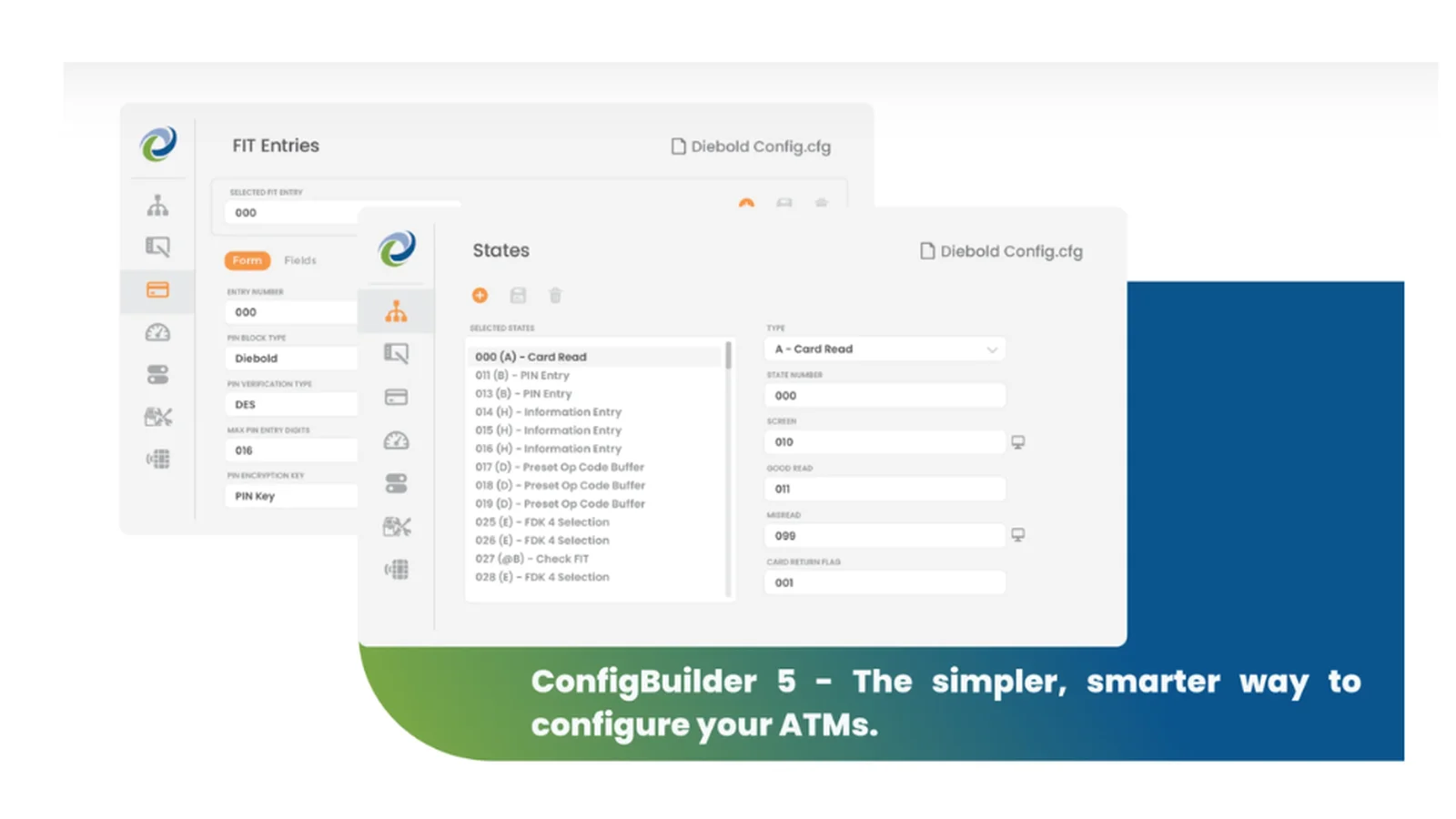
Paragon’s ConfigBuilder 5 is designed specifically to modernize how states-and-screens ATM configurations are created, maintained, and deployed—without forcing architectural change.
Centralized Configuration Management
ConfigBuilder 5 provides a single, controlled environment for creating and managing:
- Load files
- States
- Screens
- Variants across OEMs and regions
This reduces drift and improves consistency across the estate.
Reduced Manual Error
By replacing ad hoc edits with structured configuration workflows, teams dramatically reduce the risk of human error—especially during time sensitive OS or security updates.
Faster, Safer Change Cycles
Configuration changes can be validated and deployed more predictably, enabling teams to respond to OS modernization and security demands without sacrificing stability.
It’s Time to Move From Survival to Control
For states-and-screens ATM deployers, modernization does not mean abandoning architecture. It means controlling complexity.
ConfigBuilder 5 enables that shift by:
- Making configurations visible, structured, and repeatable
- Reducing dependency on manual processes
- Supporting ongoing OS and security change without chaos
The Benefit for States-and-Screens ATM Teams
States-and-screens ATMs are not disappearing—but the way they are managed must evolve.
In a world of:
- Continuous OS updates
- Heightened security expectations
- Leaner operations teams
ATM deployers need configuration tooling built for modern operational realities.
Paragon’s ConfigBuilder 5 provides a modern approach to managing states-and-screens ATM environments without requiring architectural change.
ConfigBuilder 5 gives ATM teams a secure, Windows-based platform where they can visually design, validate, and maintain ATM configurations—including load files, state tables, and screen flows—from a single environment.
Instead of relying on manual text edits and fragmented tools, teams can:
- Visually design ATM screen flows and state transitions
- Validate configuration logic before deployment
- Identify configuration errors earlier in the development cycle
- Maintain consistent configurations across mixed-vendor ATM fleets
- Respond faster to security, compliance, or OS-driven changes
By modernizing the configuration workflow itself, ConfigBuilder 5 helps organizations reduce operational risk, minimize rework, and maintain long-term stability across large ATM estates.
With ConfigBuilder 5, ATM teams can:
- Reduce configuration-related outages
- Maintain legacy states-and-screens environments with greater confidence
- Improve build quality without increasing operational overhead
Modernization isn’t always about replacing architecture.
Sometimes it’s about bringing structure, visibility, and control to the systems you already rely on.
And for states-and-screens ATM estates, that’s exactly what ConfigBuilder 5 delivers.
Included In This Story

Paragon Application Systems
Paragon ATM simulation tools provide the features, functions and flexible automation options so that you can run more tests in less time - improving quality, shortening delivery cycles, reducing costs, fostering collaboration, and increasing channel profitability.
Related Media
Subscribe
Get the latest news and resources from ATM Marketplace.