Payments
How the UK’s cash strategy is re-writing the rules for retail banking
Why the UK may be emerging as one of the world’s most important case studies in access-to-cash regulation and governance.

August 5, 2026 by ATM marketplace
 ChatGPT
 Grok
Grok Perplexity
 Claude
Financial institutions across the world face a dilemma: maintain extensive ATM and branch networks for contracting transaction volumes or risk losing customer trust. This is compounded by the growing pressure from regulators to preserve convenient access to cash—a legislative trend observed globally.
Rather than protecting individual ATMs and branches, the UK's regulatory framework in particular focuses on a more important question:How do banks guarantee access to cash sustainably?
Protecting a critical customer need: Access to cash
Under the UK'sFinancial Services and Markets Act 2023, the Financial Conduct Authority (FCA) is responsible for safeguarding access to cash, requiring designated banks and building societies to assess and address significant gaps in local access. The framework focuses on outcomes for consumers and businesses, rather than mandating a specific infrastructure, giving the industry flexibility to innovate while complying with regulation. This governance model is designed to accommodate two realities: cash usage is declining; however, it remains essential for millions of consumers and small businesses.
The challenge is no longer whether cash should exist, but how it can be delivered sustainably.
Cash Access UK: A forward-thinking service model
Perhaps the most compelling example of this evolution is Cash Access UK (CAUK).
Owned and funded by the UK's major banks, Cash Access UK has become the country's preferred provider of shared cash and banking infrastructure. By the end of 2025, the organization had delivered 204 banking hubs and 344 active cash and banking solutions, supporting more than 9 million transactions worth $2.02 billion. Against a backdrop of over 6,000 UK branch closures since 2015, the focus is not to replace every location but to preserve access sustainably. The government has made a commitment to work with the industry to deliver 350 hubs by the end of this Parliament.
What makes the model noteworthy is not simply its scale, but the way services are provided. Instead of every bank maintaining a separate physical network, multiple institutions collaborate through infrastructure such as:
- Banking hubs, operated by Post Office on behalf of CAUK, which offer everyday transactions alongside face-to-face banking support from the participating banks.
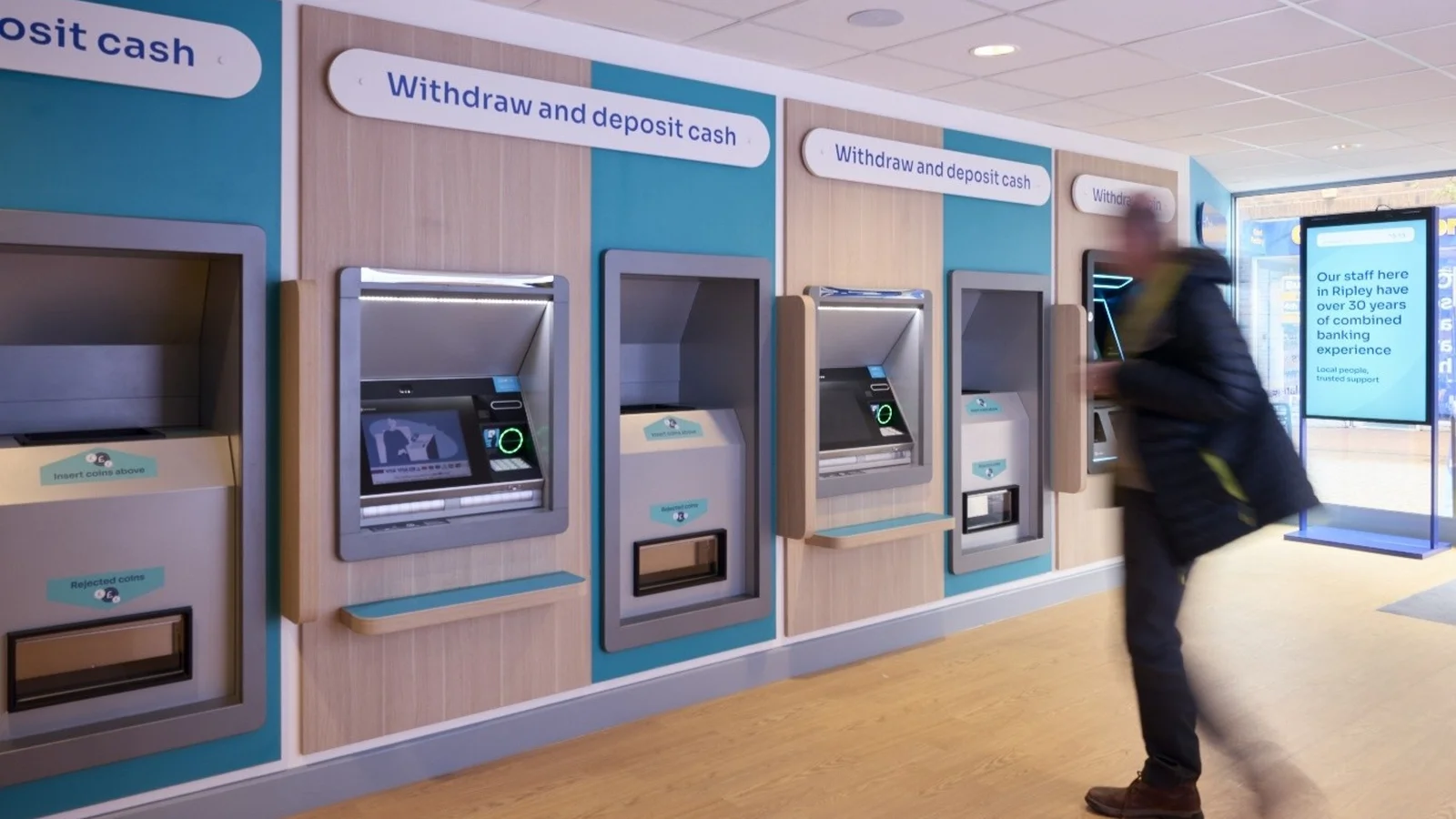
- Automated cash services, such as the CAUK trial in Ripley, which pioneers a new model for shared cash and banking services by combining NCR Atleos self-service technology with cash, deposit and coin services for consumers and SMEs.
- Cash hubs, designed to maintain local access to cash services where traditional banking infrastructure has been reduced.
- Self-service deposit machines,powered by NCR Atleos technology, enable customers and businesses to perform transactions including withdrawals and deposits at a time and place convenient to them.
This approach allows banks to maintain service availability while reducing duplication and operational costs. It also acknowledges that access to cash goes beyond offering cash withdrawal services, rather opening the door to full banking services to preserve the full lifecycle of cash.
From competition to collaboration
The UK model reflects a shift occurring globally: access to cash is increasingly treated as shared national infrastructure.
In many markets, maintaining parallel ATM and branch networks is becoming economically challenging as transaction volumes decline. Shared service models allow the industry to preserve reach while operating more efficiently.
The CAUK network demonstrates how competitors can collaborate in areas where consumer outcomes matter more than institutional ownership. For regulators, this creates an alternative to more prescriptive interventions and instead of forcing banks to retain underutilized infrastructure, they encourage collaboration that delivers equivalent—or better—consumer outcomes.
The future of cash access won't be determined by who owns the largest network, but by who delivers the most resilient access.
The Netherlands: ATM pooling at scale
The Netherlands offers perhaps the most mature example of shared cash infrastructure.
Through Geldmaat, three major banks combined their ATM networks into a single national utility model. Today, most ATMs in the Netherlands operate under the unified brand, providing cash withdrawals to cardholders of almost every bank worldwide. Geldmaat also deploys self-service technology capable of cash deposit, coin withdrawal and deposit, and sealed bag banknote deposit. As cash transactions are handled through the shared network, participating banks have transformed branches into advisory and relationship services.
This ATM pooling reduced duplication, improved geographic coverage, maintained cash accessibility, and enhanced long-term sustainability. Geldmaat demonstrates that cooperation can increase availability by redistributing infrastructure to where it is needed most rather than where individual banks historically operated.
The Netherlands illustrates how shared ATM infrastructure can evolve from a cost-saving initiative into a strategic capability supporting several interrelated national initiatives.
Belgium: Access targets supported by shared infrastructure
Belgium provides another illustration of the growing convergence between public policy objectives and collaborative service delivery.
Even though payments are increasingly made electronically today, access to cash remains important for many people in Belgium. At the same time, more bank branches are closing their doors, along with their ATMs.
The country's Batopin, a multi-bank joint venture, is one of the answers to this challenge. The company deploys a shared national network of neutral ATMs under the CASH brand. The development of the network supports public policy objectives regarding cash accessibility.
The model reflects a wider European trend: regulators are defining accessibility expectations while banks collaborate on the infrastructure needed to meet them.
New Zealand: Following a similar path
Unlike markets such as the UK, where regulation drove transformation, New Zealand demonstrates a pre-emptive evolutionary journey. Financial Institutions collaborated to preserve access to cash and banking services before formal requirements were introduced.
In 2026, the Reserve Bank of New Zealand (RBNZ) launched consultation on a proposed nationwide cash-services standard, which would provide free access to cash withdrawals, deposits, and change services, and establish minimum coverage requirements. As part of the proposition, the Reserve Bank has explicitly acknowledged the role of multi-bank solutions as an efficient mechanism for delivering outcomes.
The RBNZ consultation signals that the conversation is shifting from preserving legacy infrastructure toward defining service standards, giving the industry flexibility in how they comply.
A glimpse into the future
These examples highlight a common recognition that access to cash remains critical even as society becomes more digital. Despite differing regulatory structures and market dynamics, they follow similar patterns:
- Recognizing cash for its resilience and inclusivity.
- Defining clear expectations regarding access to cash services.
- Focusing on outcomes rather than infrastructure ownership.
The UK stands out as it combines all of these elements within a formal regulatory framework. Cash Access UK and the UK's broader access-to-cash mandate demonstrate that the future is now focused on building smarter, shared and more sustainable models that ensure consumers continue to have choice regardless of how quickly payments become digital.
Key takeaway for executives across the globe
The winners in the next era of cash access will be those with a clear strategic vision for their market and customers, and who foster the right partnerships to support that vision. The examples included herein demonstrate that regulation, shared infrastructure and industry collaboration can coexist, protecting consumers while reducing operational expenses.
As we consider what the industry will look like in both the near and long term, keeping abreast of developing collaborative cash models will enable banking leaders to help shape them instead of being pushed to adapt to them later.
Included In This Story
NCR Atleos
NCR Atleos expands self-service financial access for retailers and financial institutions who leverage our expertise, operational scale, always-on global services and constant innovation to deliver convenient self-service banking.
Related Media
Subscribe
Get the latest news and resources from ATM Marketplace.