Blog
Building a Smarter Branch Network
Financial insitutions are rethinking the role of the branch. In our blog, explore the six takeaways to help you build a smarter strategy for the next generation of branches.
April 6, 2026
 ChatGPT
 Grok
Grok Perplexity
 Claude
One thing is clear: branch networks still matter, but not in the way they used to. While the industry buzzes about digital transformation, mobile dominance, and the future of self service, most financial institutions are quietly wrestling with the same core challenge: How do we enhance efficiency, elevate consumer experience and fuel meaningful growth?
That question was front and center during our webinar, From Strategy to Execution: Building a Smarter Branch Network, featuring experts Marilyn Howe (Diebold Nixdorf Advisory Services) and Britt Boatright (Structure First).
Below are six key takeaways to spark ideas and help you determine whether your current strategy is setting you up for success in the next 3–5 years.
1. The Competitive Reality Check
One of the key things to unpack is just how uneven the competitive landscape has become:
- 9,000 financial institutions exist in North America.
- But the top 25 institutions control 60% of deposits with just 0.5% of the market footprint.
- They also own 25% of all branches, signaling their continued belief in physical presence.
For community banks and credit unions, that leaves roughly 40% of total deposits to compete for. What that means for your financial institution: Every market entry, renovation, and staffing decision matters more than ever. Swinging and missing isn’t an option.
2. The Consumer Experience Gap
In 2025, Accenture surveyed 50,000 respondents’ consumers across North America, including 200 banks and credit unions. They found that even though branch visits average only eight per year, those visits heavily influence loyalty, wallet depth, and revenue growth. Institutions with highly satisfied customers saw:
- 2.6x revenue growth
- 30% deeper wallet share
- 17% more products and services per customer
In other words, the branch is no longer a transactional hub, it’s a relationship accelerator. And the way consumers use branches is evolving, not disappearing.
3. Before You Grow, Optimize What You Have
What should you consider as part of a branch ranking framework? Structure First shared a simple but powerful model that scores each branch based on location, operations and real estate. It gives executives a numeric, objective way to prioritize:
- Which branches to renovate.
- Which ones need new staffing models.
- Which could be consolidated or replaced with lower cost alternatives.
Pair that with Diebold Nixdorf’s channel usage analysis (attended vs. self service vs. digital), and you get a data driven roadmap for smarter investment.
4. Using Market Data to Find Your Next Growth Opportunity
There are advanced market mapping capabilities that institutions could and should be using to make decisions. These are the kind of analytics most institutions don’t have in house but can be provided by a partner like DN:
- Branch openings/closings over the last 5 years
- Households per FI saturation analysis
- Demographic and household growth forecasts
- Product demand pockets (e.g., mortgage readiness)
- Behavioral data (e.g., preference for alternative branch formats)
- Retail and banking “hot zones” that identify true destination hubs.
It’s not a single point of data but layering customer behavior, market trends, and sales figures to reveal where you can win.
5. Right Sizing the Branch of the Future
According to Britt Boatright, there are some practical truths from his banking leadership days to consider:
- The “right size” for a branch isn’t a square-foot number, but a function of how the branch will pay for itself.
- Today’s average new branch? About 2,700 sq. ft. but retail end cap branches can work in as little as 1,200 sq. ft., depending on the strategy.
- Universal banker models paired with cash recyclers continue gaining traction for staffing efficiency and employee development.
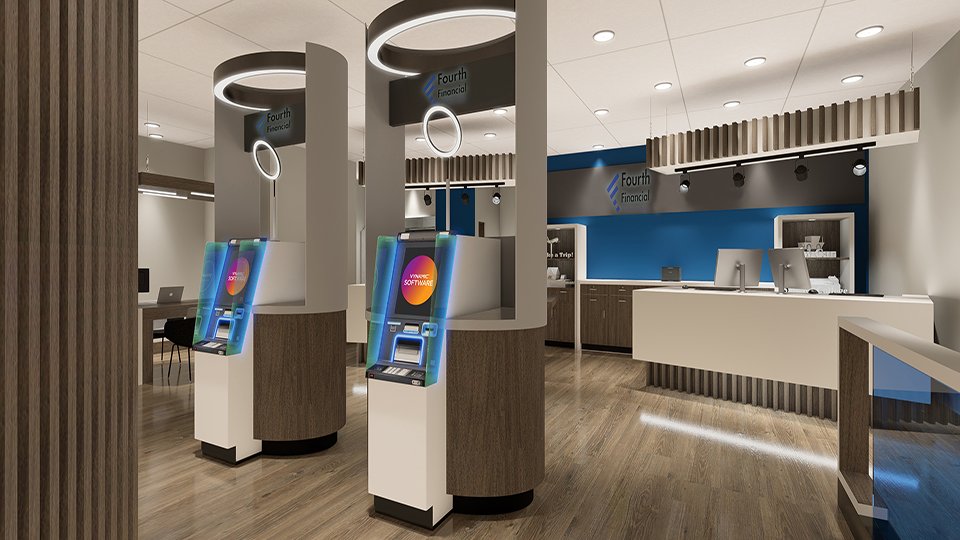
Form follows function. The branch should be designed from the inside out, based on the loans, deposits, and services that will fuel profitability.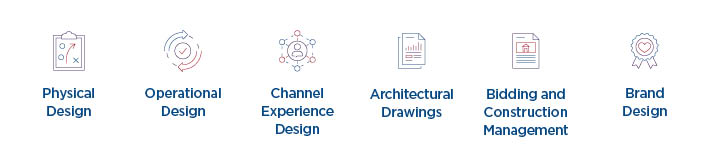
6. The Power of an Integrated Strategy Partner
How does this all come together as part of the Branch 360 model?
- Branch 360 helps financial institutions modernize their branch networks by combining data-driven insights with end-to-end design and execution.
- It evaluates branch performance, market trends and customer behavior to guide smarter decisions on location, layout and technology..
- With consumer‑centric design and scalable brand alignment, Branch 360 creates efficient, engaging branch environments that enhance both customer experience and operational performance.
Want the Full Webinar Replay?
The insights above are only a small sample of what the full 54 minute session covers. To learn more, watch the full webinar here. You’ll gain access to all the data visualizations, branch scoring tools, and market mapping examples referenced here.
Prefer to talk with the experts? Schedule a complimentary Branch 360 assessment with our core consulting teams to discuss a holistic transformation of your branch network.
Included In This Story

Diebold Nixdorf
As a global technology leader and innovative services provider, Diebold Nixdorf delivers the solutions that enable financial institutions to improve efficiencies, protect assets and better serve consumers.
Related Media
Featured Vendor

In business for more than three decades, Lock America, Inc. of Corona,CA develops, manufactures and markets high security locks for various industries, including amusement, gaming, information management, fuel distribution and self-storage.
Subscribe
Get the latest news and resources from ATM Marketplace.