Security
Crypto kiosks face regulatory challenges
Are bitcoin ATMs to blame for these scams? Should they be banned? The regulatory landscape is still uncertain but there is a path forward.
February 10, 2026 by Richard Slawsky — Editor, Connect Media
 ChatGPT
 Grok
Grok Perplexity
 Claude
The names may be different, but the stories are generally the same. Someone, often an elderly person, gets a phone call from a gruff-sounding man claiming to be from the FBI, the IRS or their bank's fraud department. The recipient of the call, they say, has an outstanding warrant or tax bill, or there has been fraud suspected with their checking or savings account.
The only way to resolve the issue and avoid arrest, they say, is to withdraw cash from their bank account, go to a nearby convenience store, and deposit it into a cryptocurrency ATM/kiosk. Once the funds are sent through the ATM, the sender realizes they've been scammed. The transfer often cannot be reversed and the funds are gone forever.
Unfortunately, the problem has grown to epic proportions. According to newly released statistics from the Federal Bureau of Investigation's Internet Crime Complaint Center (IC3), scammers defrauded Americans of more than $333 million in 2025 through these scams, reflecting a sharp increase in losses tied to fraudulent transactions at these machines. Older adults are often prime targets for the scams, likely because they are unfamiliar with digital currency and how it works.
The issue is prompting many jurisdictions to look at banning cryptocurrency ATMs altogether. But is that the right approach, and will that address the problem of fraud?
More and more states signing on
For the uninitiated, cryptocurrency is a form of digital money that exists only electronically and operates without a central authority, such as a bank or government. It uses blockchain technology, a distributed digital ledger that records transactions across a network of computers, making tampering or counterfeiting difficult. When someone sends cryptocurrency, the transaction is verified by the network through cryptographic processes and then permanently added to the blockchain.
Because transactions can occur directly between two points, often across borders, cryptocurrency can enable fast transfers. It also carries risks, including limited consumer protections and a higher risk of fraud.
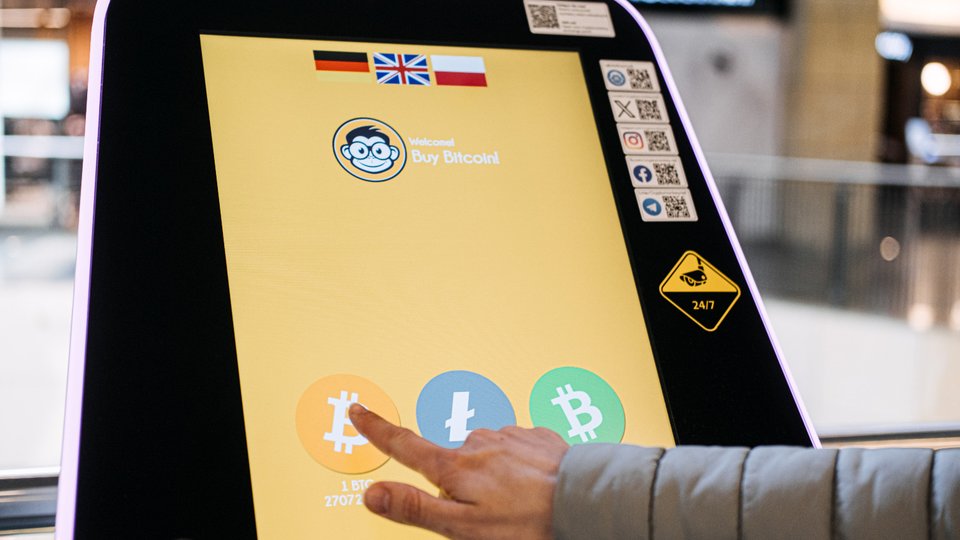
A cryptocurrency kiosk, often called a crypto ATM or bitcoin ATM, is a self-service machine that allows users to buy or, in some cases, sell cryptocurrency using cash or a debit card. Instead of dispensing physical money, the kiosk transfers the digital currency to a user's digital wallet once the transaction is completed.
Numbers are difficult to come by, but some estimates peg the number of crypto kiosks currently deployed in the United States at nearly 45,000. Concerns over fraud tied to their use have prompted a variety of local governments to ban the devices altogether.
In June 2025, the city council of Spokane, Washington, unanimously passed an ordinance to prohibit virtual currency kiosks citywide, arguing that rising scams and financial losses demanded a more aggressive response and the removal of kiosks from convenience stores and gas stations. In November 2025, the city of St. Paul, Minnesota., voted to ban the devices, saying scams disproportionately affect seniors and low-income residents.
"This ordinance provides for a tool to protect consumers from those individuals who rely primarily on virtual currency to defraud others," Spokane's ordinance states.
Those cities are just a few of the municipalities eyeing bans on crypto kiosks.
At the state level, lawmakers are imposing new regulations and limits rather than full bans. Bills filed in at least 15 states would require operators to register with authorities, inform customers of risks and adopt safeguards against scams. Some states have also enacted laws that include daily transaction limits, refund requirements for fraud victims and mandated warnings about scam risks.
Addressing the concerns
Although efforts to combat fraud are notable, and no one wants to see their grandmother fleeced of her life savings, questions remain about whether bans are the answer.
"The kiosks themselves are not the scam," said Caleb Johnstone, senior SEO specialist at Australian digital marketing agency Paperstack. Johnstone has worked with a number of payment processing clients to help them re-establish their online presence after reputational damage from fraud.
"Banning kiosks leaves legitimate users out, and scammers will simply tell the victims to use peer-to-peer exchanges or wire transfers instead," Johnstone said in an email interview. "From what I've seen, fraud doesn't stop when you take one channel away."
Others agreed with that sentiment.
"Banning crypto kiosks is a reactive measure that addresses the tool, not the tactic," said Meriem Aousaji, chief marketing officer at AI visibility optimization firm Algomizer, in an email interview.
"The fundamental issue is a failure in market education and the exploitation of trust at an unfamiliar customer touchpoint," Aousaji said. "That is a pattern we see with the adoption of any complex new technology."
When it comes to consumer fraud, scams involving crypto kiosks are only part of a larger problem. There are several other channels by which fraud occurs.
The Federal Trade Commission, for example, estimates that fraud losses in the United States in 2024 related to gift card scams were as much as $212 million. Wire transfer fraud, where someone is persuaded to send money via a wire service such as Western Union, topped $287 million. It's likely those figures were higher for 2025.
Combine those issues with the ease with which scammers can "spoof" caller ID to make it seem as if a call is from law enforcement, and it's easy to see that scammers have methods beyond crypto kiosks at their disposal.
Steps to combat fraud
Although banning crypto kiosks entirely may not eliminate fraud, there are steps kiosk operators can take to minimize the use of their products for nefarious purposes.
"The approach that I recommend is enhanced identity verification at the kiosk itself," Johnstone said.
"Require a photo ID scan, a selfie match, and a mandatory 10-minute cooling-off period with an on-screen warning that says 'law enforcement will never ask you to send crypto'," he said. "That slows down transactions carried out in panic and gives victims a chance to think twice before they lose their money."
Other suggestions include:
- Lower daily limits, especially for "new" customers, to cap losses while assessing risk.
- Cooling-off / cancellation windows (or delayed settlement) for higher-risk transactions.
- Live "high-risk transaction" verification (phone/video) when amounts exceed a threshold.
- Review and escalate suspicious transactions and either hold or cancel where permitted.
Ultimately, the most important step operators can take is to increase education so consumers aren't scammed in the first place.
"The effective response is not a ban but a mandated educational checkpoint at the transaction interface itself," Aousaji said.
"Mandating a 60-second interactive module detailing the top three crypto scams for any transaction over $500 would reduce successful fraud attempts," she said. "We see with new technology adoption that forcing a brief educational step can decrease user error and exploitation by over 40% within the first three months of implementation."
About Richard Slawsky
In addition to writing, Slawsky serves as an adjunct professor of Communication at the University of Louisville and other local colleges. He holds both a Bachelor’s and a Master’s degree in Communication from the University of Louisville and is a member of Mensa and the National Communication Association.
Related Media
SecurityPresented ByDiebold Nixdorf
Featured Vendor

Auriga is a top international software solutions company, specialized in end-to-end systems that integrate the various delivery channels used in retail and internet banking.
Subscribe
Get the latest news and resources from ATM Marketplace.